Hello, Friends! Standing between the posts means taking on responsibilities unlike those of any other player on the soccer field.
A goalkeeper can use their hands in specific situations, launch an attack with a long throw, or leave the penalty area to intercept a dangerous pass.
However, these special privileges come with strict rules, and even a small mistake can result in a free kick, corner, or disciplinary action. Whether playing competitively or simply learning more about soccer, these five goalkeeper rules show just how much knowledge is needed to protect the goal effectively.
Every Team Must Have a Goalkeeper
A soccer team must always designate one player as its goalkeeper while the match is being played. If the starting goalkeeper is injured, substituted, or sent off, someone else must take over the position before play can properly continue.
That replacement does not necessarily have to be a specialist goalkeeper. An outfield player can switch positions with the goalkeeper, provided the referee is informed, and the change is made during a stoppage in play.
This situation becomes particularly important after a red card. If a team has no suitable substitution available, an outfield player may have to put on the goalkeeper's jersey and finish the match in goal. The rules therefore protect the position itself rather than guaranteeing that a trained goalkeeper will always occupy it.
The Goalkeeper Must Be Visually Distinct
The goalkeeper's clothing must clearly distinguish them from the other players and match officials. This is more than a matter of tradition. Because goalkeepers have special permission to handle the ball in their own penalty area, referees need to identify them instantly during fast-moving situations.
Like other players, goalkeepers must wear the required basic equipment, including a shirt with sleeves, shorts, socks, shin guards, and footwear. Additional protective equipment may also be permitted when it is considered safe.
Interestingly, goalkeeper gloves are not compulsory under the Laws of the Game. They are nevertheless almost universally worn because modern gloves can improve grip while providing cushioning against powerful shots. Some designs also incorporate finger-support structures, although the goalkeeper must still be able to move naturally and safely.
Handling Privileges End at the Penalty-Area Line
The goalkeeper is the only player who can deliberately handle the ball during normal play, but this privilege exists only inside their own penalty area. One detail frequently causes confusion: the position of the ball determines whether handling is legal. Imagine a goalkeeper standing with both feet beyond the penalty-area line while leaning backward to catch a ball that remains inside the box.
The handling can still be legal because the ball has not completely left the penalty area. The opposite situation creates a problem. A goalkeeper standing inside the box cannot reach beyond the boundary and deliberately handle a ball that is outside it. Once outside their own penalty area, goalkeepers are treated like ordinary outfield players under the handball rules.
Leaving the box is therefore a calculated decision. Modern goalkeepers often rush forward to clear passes played behind their defenders, but mistiming that movement can produce serious consequences. Depending on the circumstances, illegal handling outside the area can result in a direct free kick and possible disciplinary action.
Not Every Ball from a Teammate Can Be Picked Up
Being inside the penalty area does not automatically give a goalkeeper permission to use their hands. A goalkeeper generally cannot handle a ball deliberately kicked directly to them by a teammate. The same restriction applies when receiving the ball directly from a teammate's throw-in. In those situations, the goalkeeper must usually control and play it without using their hands.
However, the rule is more precise than simply saying that a goalkeeper cannot receive a "back-pass." A genuine header, chest pass, or other legal play from a teammate may normally be handled. Accidental kicks and deflections can also be judged differently from a deliberate kick intended for the goalkeeper.
Players are also prohibited from deliberately manufacturing a trick to avoid the restriction. For example, intentionally flicking the ball into the air specifically so a teammate can head it back to the goalkeeper's hands can be penalized as an attempt to circumvent the Law.
These restrictions have helped transform modern goalkeeping. Keepers are now expected to control passes confidently with their feet and participate in building attacks rather than simply waiting near the goal.
The Eight-Second Rule Keeps the Match Moving
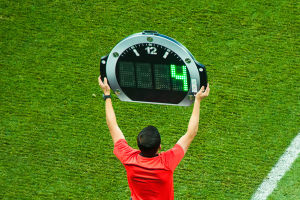
For many years, soccer fans knew this as the six-second rule. That information is now outdated. Under the current Laws of the Game, a goalkeeper may control the ball with the hands or arms inside the penalty area for a maximum of eight seconds. The referee uses a visible countdown for the final five seconds, giving the goalkeeper a clear warning that possession must soon be released.
If the eight-second limit is exceeded, the opposing team is awarded a corner kick from the side closest to where the goalkeeper was positioned when penalized. A yellow card is not automatically shown for a first violation, although repeated offenses can lead to disciplinary action.
Control begins when the goalkeeper genuinely secures the ball. Holding it against the body, carrying it in the hands, balancing it on an open palm, bouncing it, or tossing it into the air while retaining control all count toward the limit. Opponents, meanwhile, cannot legally challenge a goalkeeper who has clear hand or arm control of the ball or unfairly prevent its release.
Goalkeeping is not simply about making spectacular diving saves. The position demands constant awareness of boundaries, possession rules, teammates, opponents, and the clock. Knowing when the hands can be used, understanding how to deal with passes from defenders, and respecting the eight-second limit can prevent costly mistakes before they happen.